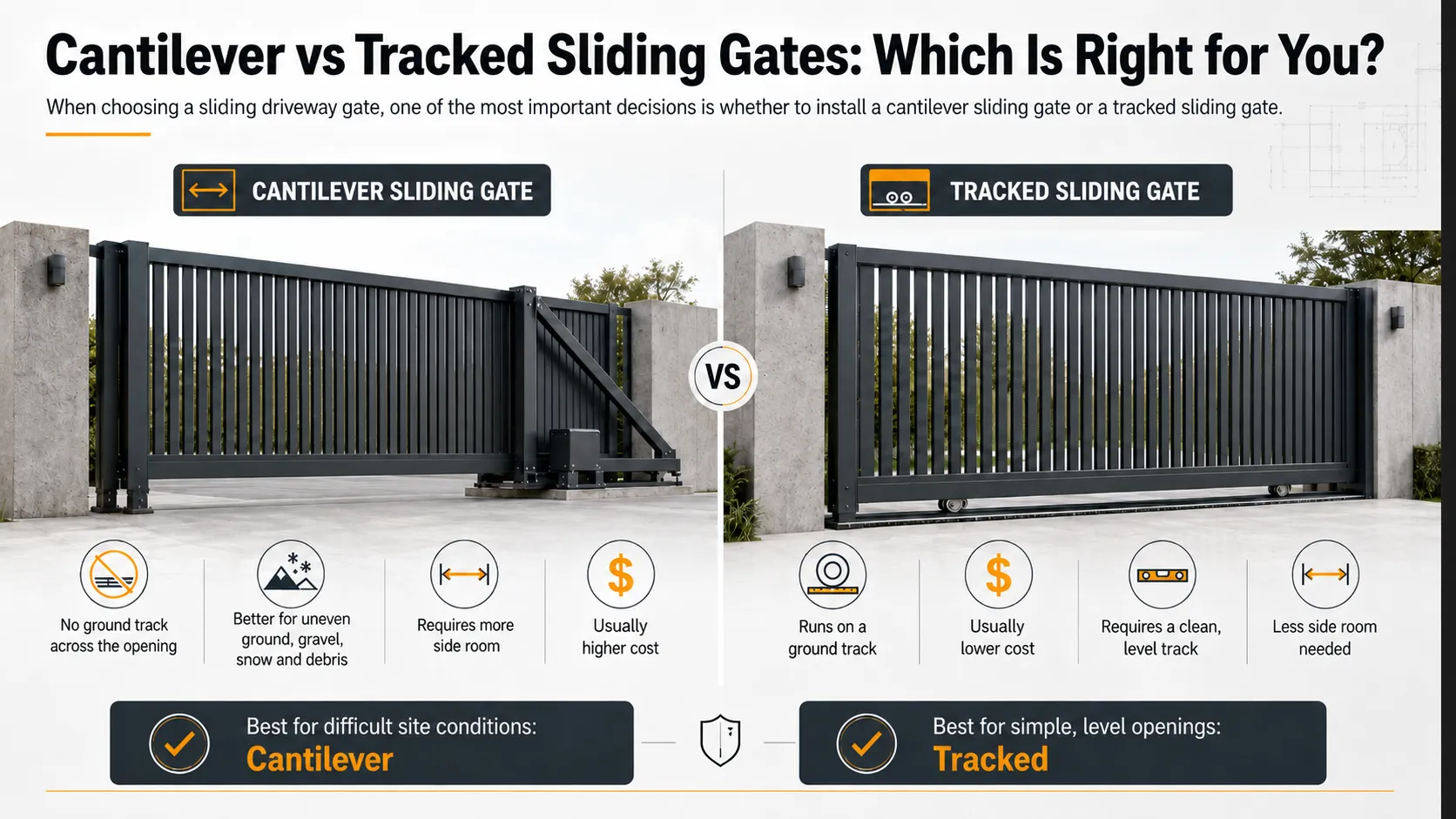
Both systems can work well, but they are not the same. The right choice depends on your driveway, ground level, budget, available space and how much maintenance you are prepared to do.
At MS Gates, we manufacture and install custom steel gates across the UK. In this article, we explain the practical differences between cantilever and tracked sliding gates, so you can choose the system that suits your property best.
What is a cantilever sliding gate?
A cantilever sliding gate does not run on a track across the driveway. Instead, the gate is supported by a special bottom beam and a set of rollers installed to one side of the opening. The gate "floats" above the ground while opening and closing.
This means there is no rail across the driveway entrance. For many properties, this is a major advantage.
What is a tracked sliding gate?
A tracked sliding gate runs on wheels along a metal track fixed into the ground across the driveway opening. The track guides and supports the gate as it moves. This is a simple and proven system, often used where the ground is flat and suitable for installing a rail.
Tracked gates can be strong and reliable, but the ground track needs to stay clean and clear.
Cantilever gates: main advantages
No track across the driveway
The biggest benefit of a cantilever gate is that there is no track across the entrance. This is useful when the driveway surface is uneven, when drainage is an issue, or when you want to avoid a rail being exposed to dirt, stones, leaves, ice or debris.
Because the gate is supported from the side, vehicles can pass through without crossing a metal rail.
Better for uneven ground
Cantilever gates are often a better choice where the driveway surface is not perfectly level. A tracked gate depends on a straight, clean and properly installed rail. If the ground moves, sinks or becomes uneven, the gate can start to run badly.
A cantilever gate avoids many of these problems because it does not rely on a rail in the driveway opening.
Lower risk of obstruction
With a tracked sliding gate, small stones, mud, leaves, ice or snow can collect in the track and affect the movement of the gate. A cantilever gate does not have this problem in the same way.
This can make cantilever gates more practical for exposed driveways, commercial yards, farms, rural properties and busy entrances.
Good for automation
Cantilever sliding gates are very suitable for automation. Because the gate moves on a roller system rather than along a ground track, there is less risk of the gate being stopped by debris in the entrance.
For automatic gates, smooth and consistent movement is very important. A well-built cantilever gate can offer excellent long-term performance.
Cantilever gates: things to consider
More space is needed at the side
A cantilever gate needs extra space behind the opening because of the counterbalance section. This means the total gate length is longer than the actual driveway opening.
For example, if your entrance is 4 metres wide, the full cantilever gate will usually need additional length to balance and support the structure. If there is not enough space to the side of the driveway, a cantilever gate may not be possible.
Usually more expensive
Cantilever gates are usually more expensive than tracked gates. This is because they require:
- A stronger gate frame.
- A special bottom beam.
- Roller carriages.
- More steel.
- More accurate fabrication.
- Stronger foundations.
However, the higher initial cost can often be justified by better practicality and reduced problems with the driveway track area.
Strong foundations are important
A cantilever gate places significant load on the roller posts and foundation area. The gate is supported from one side, so the foundation must be strong enough to carry the weight and movement of the gate safely.
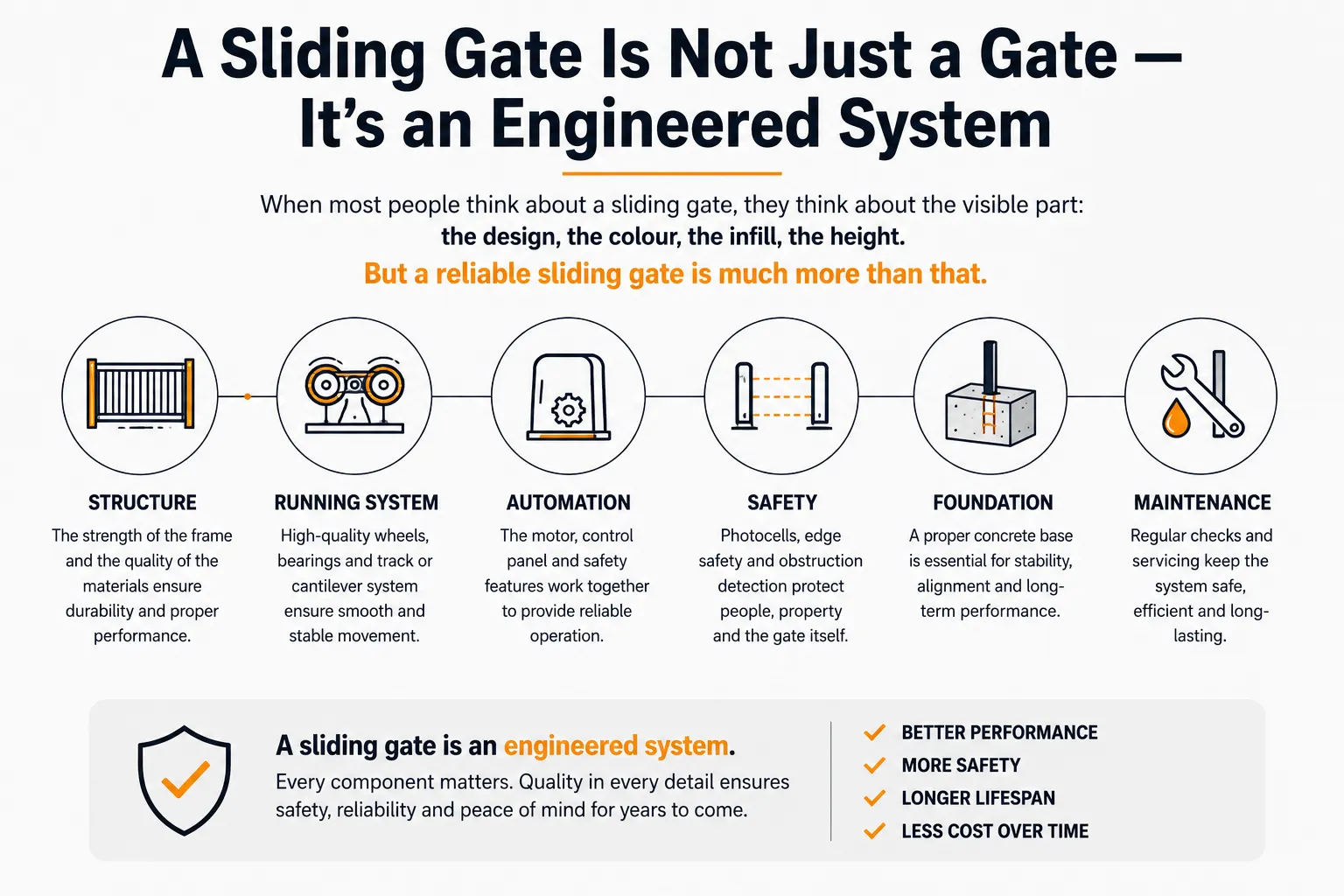
Good installation is essential. A poorly installed cantilever gate can cause problems later. We cover this in more detail in our article on why a sliding gate is an engineered system.
Tracked sliding gates: main advantages
Simpler construction
Tracked sliding gates are generally simpler in design. The gate runs on wheels, and the track carries much of the weight. This can make the gate easier and cheaper to manufacture compared with a cantilever system.
For some properties, especially with a flat and clean driveway surface, a tracked gate can be a good practical option.
Less side space required
A tracked sliding gate usually needs less total side space than a cantilever gate. Because there is no counterbalance section, the gate only needs to slide approximately the width of the opening.
This can be useful where there is limited room beside the driveway.
Often lower cost
Tracked gates are usually more affordable than cantilever gates. If the driveway is suitable and the track can be installed correctly, a tracked sliding gate may offer a strong and cost-effective solution.
Tracked sliding gates: things to consider
The track must stay clean
The main disadvantage of a tracked gate is the ground rail. Leaves, stones, mud, snow or ice can collect in the track. If the track becomes blocked, the gate may struggle to open or close properly. For automatic gates, this can cause inconvenience and may put extra strain on the motor.
Not ideal for uneven driveways
Tracked gates work best on flat, stable ground. If the driveway is uneven, slopes across the entrance, or is likely to move over time, the track may become a weak point. Any movement in the ground can affect how smoothly the gate runs.
Drainage can be a problem
Water can collect around the track if drainage is poor. In winter, this can lead to freezing. In other conditions, dirt and debris can build up. Over time, this may increase maintenance and affect gate performance.
Quick comparison
| Feature | Cantilever | Tracked |
|---|---|---|
| Ground track across driveway | No | Yes |
| Good for uneven ground | Yes | Not always |
| Side space required | More | Less |
| Maintenance around entrance | Lower | Higher |
| Risk of debris blocking movement | Lower | Higher |
| Cost | Usually higher | Usually lower |
| Best for automation | Very good | Good, if track stays clear |
| Foundation requirements | Strong side foundation | Track and posts |
When we recommend cantilever gates
At MS Gates, we often recommend cantilever sliding gates when the customer wants a strong, reliable and low-maintenance solution. They are especially suitable for:
- Residential driveways.
- Commercial entrances.
- Wide openings.
- Automatic gate systems.
- Uneven driveway surfaces.
- Areas with mud, leaves, stones or snow.
- Properties where a ground track would be inconvenient.
A properly built steel cantilever gate is one of the most reliable sliding gate systems available.
When a tracked gate may be suitable
A tracked gate may be suitable when:
- The driveway is flat.
- The ground is stable.
- Drainage is good.
- The track can be kept clean.
- There is not enough side space for a cantilever gate.
- The customer wants a lower-cost sliding gate option.
In the right conditions, tracked gates can work very well. The key is making sure the site is suitable before choosing this system.
Our honest advice
If you want the most practical and reliable sliding gate system, a cantilever gate is often the better long-term choice. It avoids many of the common problems caused by ground tracks, especially dirt, stones, ice and uneven surfaces.
However, if your driveway is flat, clean and space is limited, a tracked sliding gate may still be a sensible option.
At MS Gates, we assess each entrance individually and recommend the gate system that makes the most sense for the property — not just what looks good on paper.
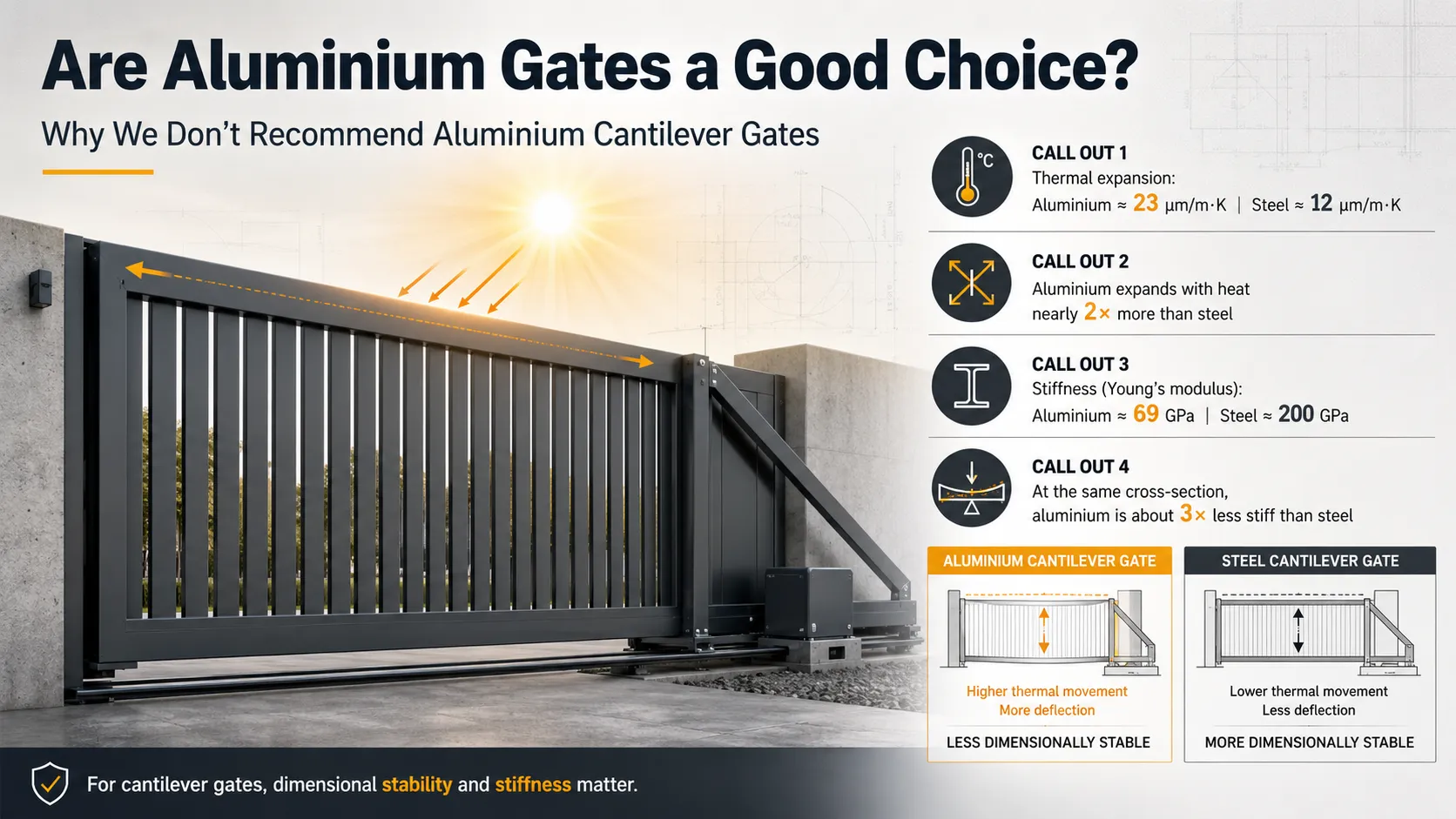
Material choice matters too — we cover why steel is better than aluminium for sliding gates in our article on aluminium vs steel.