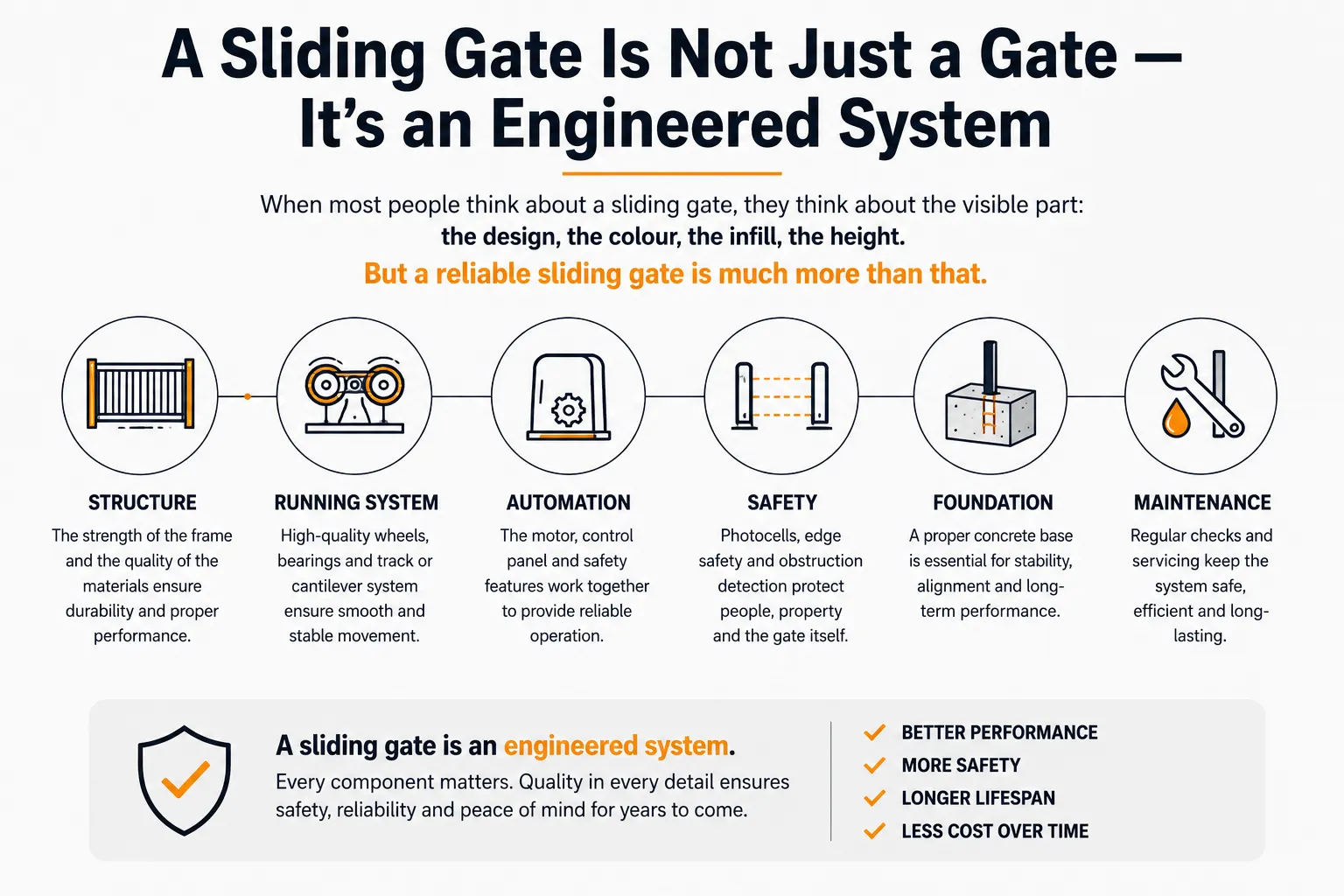
A sliding gate is not just a metal frame that moves left and right. It is an engineered system made up of structure, balance, weight, rollers, foundations, automation, alignment and material choice.
If one of these elements is wrong, the gate may still look good on the first day — but problems can appear later.
At MS Gates, we have been manufacturing and installing custom steel gates for many years. From experience, we know that the difference between a good gate and a problematic gate is often hidden in the details that most customers never see.
The gate itself is only one part of the system
A sliding gate has to do more than look attractive. It must:
- Move smoothly.
- Stay straight.
- Remain stable in different weather conditions.
- Work with the automation system.
- Be supported correctly.
- Be strong enough for daily use.
This is why a proper sliding gate should be treated as a complete system, not just as a decorative panel. The visible design is important, but the real quality is in the structure behind it.
Why structure matters
A sliding gate is a large moving object. Depending on the size, it can be several metres long and very heavy. That means the frame must be strong enough to resist bending, twisting and movement over time.
If the frame is too weak, the gate may start to lose its shape. This can affect how it runs, how it closes, how it aligns with the posts and how the automation performs.
That is why proper steel construction is so important.
Cantilever gates need even more careful design
A cantilever sliding gate is one of the best sliding gate systems when it is designed and installed properly.
Unlike a tracked gate, a cantilever gate does not run on a rail across the driveway. Instead, it is supported by roller carriages on one side and "floats" above the ground.
This brings many advantages, especially where the driveway is uneven, dirty, exposed to leaves, stones, mud, ice or snow. But it also means the gate must be correctly engineered.
A cantilever gate needs:
- A strong bottom beam.
- Correct counterbalance.
- Rigid steel frame.
- Properly positioned rollers.
- Strong foundations.
- Accurate alignment.
- Enough space to slide open safely.
If the gate is too flexible, too light, badly balanced or poorly installed, the roller system and automation will have to fight against the structure. That is when problems begin.
For a detailed comparison of cantilever and tracked systems, see our article on cantilever vs tracked sliding gates.
The automation cannot fix a badly built gate
One of the most common misunderstandings is that a good motor can solve gate problems. It cannot.
Automation is designed to move a properly built and properly balanced gate. It is not designed to force a poor structure to work.
If the gate is heavy to move by hand, badly aligned, twisted, dragging, bending or poorly balanced, the motor will be under unnecessary strain. This can lead to:
- Unreliable opening and closing.
- Motor overload.
- Faster wear.
- Noise.
- Safety issues.
- Repeated adjustments.
- Expensive repairs.
Foundations are not an afterthought
The foundation is one of the most important parts of a sliding gate installation.
For a cantilever gate, the foundation carries a lot of load because the gate is supported from one side. If the foundation is weak, too small or poorly prepared, the whole system can move out of alignment. Even small movement in the posts or roller base can affect how the gate runs.
This is why proper ground preparation matters. Before choosing a gate, it is important to consider:
- Ground level.
- Soil condition.
- Drainage.
- Driveway slope.
- Available side space.
- Gate weight.
- Post position.
- Automation position.
- Long-term stability.
A gate is only as reliable as the structure supporting it.
Material choice matters
The material used for the gate has a major impact on strength, stiffness and long-term performance.
At MS Gates, we prefer steel for sliding gates because steel offers excellent strength and rigidity. For large moving structures, this is very important.
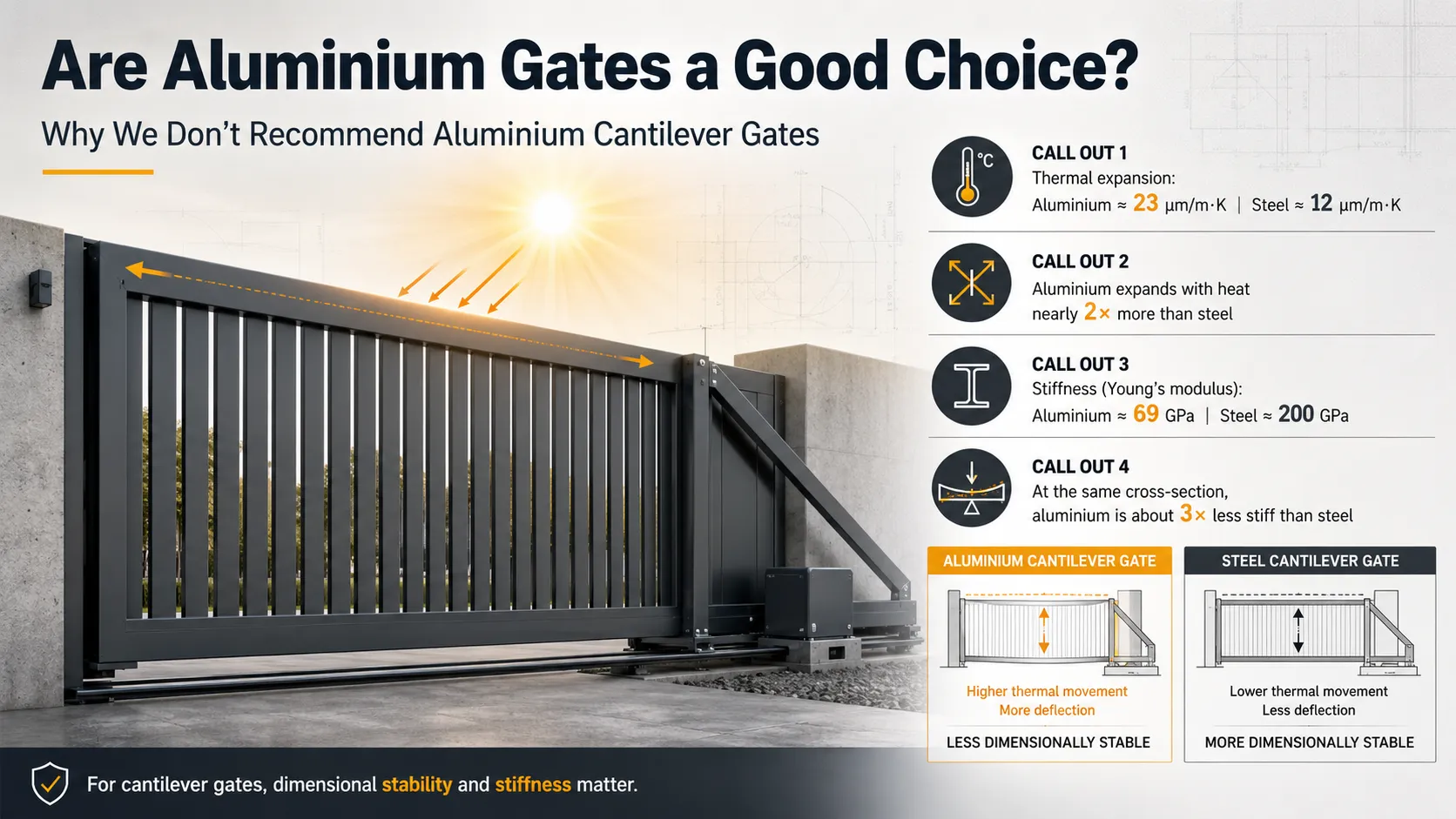
Some gates are made from aluminium because aluminium is lightweight and corrosion-resistant. However, lightweight does not always mean better. For sliding gates, especially cantilever gates, stiffness is extremely important. A gate must hold its shape and remain stable while moving, stopping, starting and being exposed to weather changes.
Aluminium expands more than steel with temperature changes and is also less stiff than steel. In real gate installations, especially with longer gates and direct sunlight, this can create problems with movement, flexing or alignment.
That is why MS Gates does not recommend aluminium gates. We believe a properly made steel gate is a better choice for strength, stability and long-term reliability. For the full reasoning, see our article on why we don't recommend aluminium cantilever gates.
A gate must be designed for the site
There is no universal gate that suits every property. A good sliding gate should be designed around the actual site conditions.
Before manufacturing or installing a gate, the following questions matter:
- How wide is the entrance?
- Is there enough space for the gate to slide open?
- Is the ground level?
- Is the driveway sloping?
- Is there enough space for a cantilever counterbalance?
- Will the gate be automated?
- Is the entrance exposed to wind?
- Is the driveway used frequently?
- Will larger vehicles need access?
- Is the surface suitable for a track, or is cantilever a better option?
These details are not small details. They decide whether the gate will work properly in real life. A gate that is perfect for one property may be completely wrong for another.
The cheapest gate is not always the cheapest solution
Many problems with gates come from trying to save money in the wrong place.
A weaker frame, smaller profile, short counterbalance, poor foundation or cheap installation may reduce the initial price, but it can create long-term problems.
A sliding gate is something you use every day. It should open and close smoothly for years, not only for the first few weeks. A poorly built gate can lead to constant adjustment, automation problems, noisy operation, poor alignment, visible movement, premature wear, repair costs and frustration for the customer.
A properly designed and installed gate may cost more at the beginning, but it is usually the better long-term investment.
Good gate design is about balance
A reliable sliding gate is a balance between many elements: strength, weight, stiffness, safety, appearance, automation, foundations, site conditions and long-term durability.
If the gate is too weak, it may flex. If it is too heavy, the automation may work harder. If the counterbalance is wrong, the cantilever system may not run properly. If the foundation is poor, the alignment may change. If the material is wrong, the gate may move or twist with temperature changes.
This is why experience matters. A good gate is not just welded together. It is planned, measured, built and installed as a complete working system.
What makes a reliable sliding gate?
A reliable sliding gate should:
- Move smoothly by hand before automation is fitted.
- Stay straight and rigid.
- Be correctly balanced.
- Have strong foundations.
- Have properly aligned posts and rollers.
- Use the right material for the size and design.
- Be suitable for the driveway conditions.
- Work with the motor, not against it.
When these things are done properly, the result is a gate that looks good, works well and lasts.
Our approach at MS Gates
At MS Gates, we do not see a gate as just a product. We see it as a complete system.
That means we consider the design, steel structure, gate length, weight, balance, roller system, foundations, automation and real site conditions before recommending the best solution.
Our goal is not only to make a gate that looks good on installation day. Our goal is to build a gate that works properly for years.
Final thoughts
A sliding gate may look simple, but behind every reliable gate is a combination of engineering, experience and correct installation.
The best gate is not always the lightest, cheapest or most decorative one. The best gate is the one that is properly designed for the property, built from the right material, installed on strong foundations and matched with the correct automation system.
A sliding gate is not just a gate. It is an engineered system.